Cooking spare ribs slowly in the oven at 225°F (107°C) is one of the best ways to get fall-off-the-bone tenderness, deep smoky flavor (even without a smoker), and juicy meat with a caramelized finish. Spare ribs are naturally tougher than baby back ribs, so low-and-slow heat is essential for breaking down connective tissue and fat.
This guide is your complete, chef-level explanation of timing, texture, preparation, seasoning, foiling, oven technique, tenderness tests, and everything related to spare ribs cooked at 225°F.
If you want restaurant-quality ribs at home, this is the method.
⭐ Quick Answer: How Long to Cook Spare Ribs at 225°F in the Oven
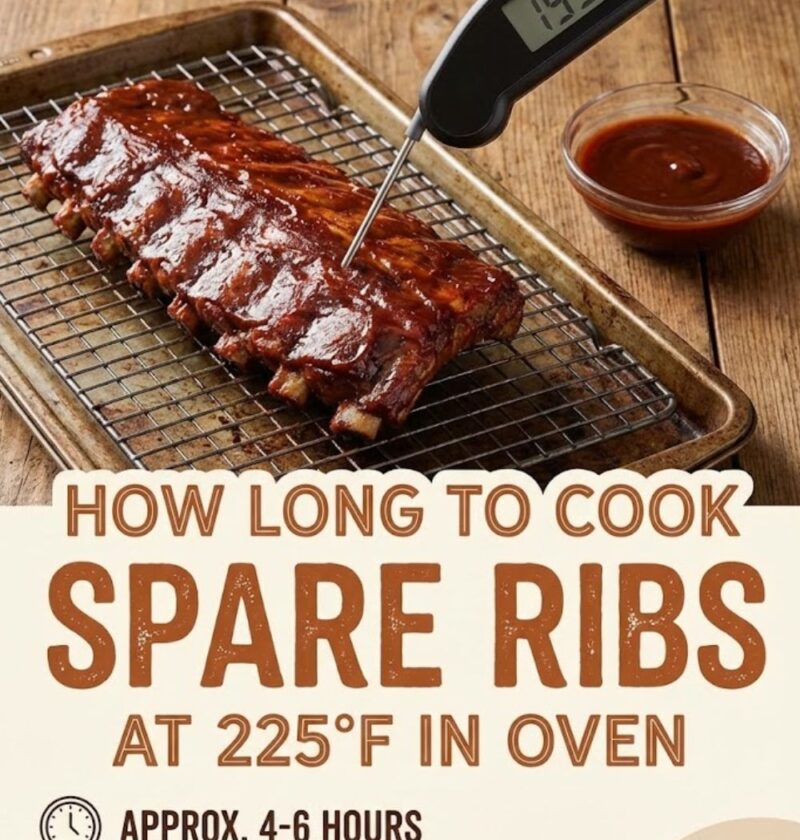
👉 Spare ribs take 4.5 to 7 hours at 225°F in the oven.
| Rib Type | Oven Temp | Time |
|---|---|---|
| Pork spare ribs (full rack) | 225°F | 5–7 hours |
| St. Louis–cut spare ribs | 225°F | 4.5–6 hours |
| Boneless spare ribs | 225°F | 3–4.5 hours |
The key:
Cook until the ribs are tender—not just for a set amount of time.
At 225°F, ribs cook gently, slowly breaking down tough fibers into silky, juicy meat.
🔥 Why 225°F Is the Magic Number for Spare Ribs
Spare ribs are full of:
- connective tissue
- collagen
- dense muscle
- tough fibers
Low temperatures slowly melt collagen into gelatin, giving that juicy, silky texture.
At 225°F:
- Fat renders slowly
- Meat stays moist
- Collagen melts gradually
- Skin doesn’t dry out
- Rib flavor deepens
Faster cooking (350°F or higher) can dry ribs out before the internal tissues break down.
225°F is the sweet spot for tenderness.

🍖 Spare Ribs vs. St. Louis Ribs: Timing Explained
Many people confuse the two.
✔ Spare Ribs
- Larger
- Thicker
- More fat
- More bone
- More connective tissue
Cook longer: 5–7 hours at 225°F
✔ St. Louis Ribs
- Trimmed spare ribs
- More even shape
- Slightly less fat
Cook slightly faster: 4.5–6 hours at 225°F
✔ Boneless Spare Ribs
These are not true ribs but strips of pork shoulder.
Cook fast: 3–4.5 hours at 225°F
🕒 Full Cooking Timeline for Spare Ribs at 225°F (Oven)
This is the most reliable rib timeline used by chefs.
1. 0–30 Minutes: Preheat & Prep
- Preheat oven to 225°F
- Remove membrane from ribs
- Season generously (rub + salt)
2. 30–240 Minutes: Slow Oven Bake (Uncovered or Covered)
Ribs slowly soften and collagen begins breaking down.
3. 4–5 Hours: Tenderizing Stage
Meat shrinks back from bones
Bones begin to poke out
Ribs bend easily
4. 4–6 Hours: Optional Foil Wrap (Texas Crutch)
Wrap ribs in foil to speed up collagen melting.
5. 5–7 Hours: Final Uncovered Browning
You may:
- add BBQ sauce
- broil
- increase heat slightly
- caramelize the edges
Total Time: 5–7 hours for classic spare ribs

🔪 How to Prepare Spare Ribs Before Cooking
✔ Remove the Membrane
This is the papery silver skin on the back.
Slide a knife under it, grab with a paper towel, and pull off.
If you skip this step, ribs can be chewy.
✔ Dry the Ribs Thoroughly
Pat them dry.
Dry ribs = better seasoning adhesion + better browning.
✔ Seasn Generously
Use a barbecue dry rub or your own mix:
Basic Rub
- Salt
- Black pepper
- Paprika
- Garlic powder
- Onion powder
- Brown sugar
- Chili powder
- Smoked paprika
Press rub firmly into the meat.
✔ Rest the Ribs Before Cooking (Optional but Powerful)
Rest in the fridge 1 hour to overnight.
This helps salt penetrate deeper.
🧂 How to Cook Spare Ribs at 225°F (Step-by-Step)
1. Preheat oven to 225°F
Slow and steady heat is essential.
2. Line a baking tray with foil
Add a rack if you have one.
3. Place ribs bone-side down
This prevents scorching and ensures even heat.
4. Cover tightly with foil or leave uncovered
Covered:
- More steaming
- Faster tenderness
- Less bark (crust)
Uncovered:
- Less steaming
- More bark
- True low-and-slow ribs
Many cooks start covered, then uncover for the last hour.
5. Cook for 4.5–7 hours
Check tenderness starting at the 4.5-hour mark.
6. Sauce and Broil (Optional)
Brush with BBQ sauce and broil 2–5 minutes for caramelization.
7. Rest 10–15 minutes
This lets juices settle and prevents dryness.

🥩 How to Tell Your Spare Ribs Are Done
Time is a guideline. Tenderness is the truth.
✔ Bend Test
Pick up ribs with tongs:
They should droop and start to crack.
✔ Bone Pullback
Bones should stick out ¼–½ inch from the meat.
✔ Toothpick Test
Toothpick should slide into meat with no resistance.
✔ Meat Temperature
Internal temp should be 190–205°F for perfect tenderness.
(Not 165°F like regular pork—ribs need hotter temps to break down collagen.)
🔥 Foil or No Foil? (Complete Explanation)
Foil Wrap (Texas Crutch)
Wrap ribs tightly after 3–4 hours.
Pros:
- Faster cooking
- Very tender
- Super juicy
Cons:
- Softer bark
- Slightly steamed texture
No Foil Method
Leave ribs uncovered the entire time.
Pros:
- Crispy bark
- Smokier flavor
- More traditional style
Cons:
- Can take longer
- Slightly drier if overcooked

🧈 The Best Oven Method: 3-2-1 Style Adapted for 225°F
Classic smoker-style ribs are cooked 3-2-1, meaning:
- 3 hours unwrapped
- 2 hours wrapped
- 1 hour uncovered with sauce
At 225°F in the oven, this works beautifully:
✔ Spare Ribs:
- 3 hours unwrapped
- 2 hours wrapped
- 1 hour finishing time
✔ St. Louis Ribs:
- 2.5 hours unwrapped
- 2 hours wrapped
- 1 hour finishing
🍽️ Best Rubs and Seasoning Styles for Spare Ribs
1. Memphis Style (Dry Rub)
No sauce. Deep, smoky flavor.
2. Kansas City Style
Sweet, sticky BBQ sauce.
3. Texas Style
Salt, pepper, paprika. Classic simplicity.
4. Carolina Style
Mustard + vinegar + pepper.
5. Asian Style
Soy sauce, brown sugar, ginger, garlic.

🍯 Best Sauces for Oven Spare Ribs
- Sweet BBQ
- Honey garlic
- Spicy chipotle
- Maple bourbon glaze
- Mustard BBQ
- Brown sugar chili glaze
Brush on during the final 30–60 minutes.
🍽️ What to Serve With Spare Ribs
Perfect side pairings:
- Cornbread
- Mac and cheese
- Coleslaw
- Potato salad
- Baked beans
- Roasted potatoes
- Grilled corn
- Pickles & onions
- Green beans
- Fries

🧊 Storage & Reheating
✔ Storage
- Fridge: 3–4 days
- Freezer: 2–3 months
✔ Reheating
Oven:
250°F for 20–30 minutes
Air fryer:
350°F for 5–8 minutes
Microwave (quick):
45–90 seconds (wrap in damp towel)
❓ Frequently Asked Questions
1. Can I cook spare ribs faster at 300°F or 350°F?
Yes, but flavor and tenderness suffer.
Higher temps create drier ribs because collagen hasn’t fully melted.
225°F gives professional BBQ-style tenderness.
2. Do ribs need to rest after cooking?
Absolutely.
Resting allows juices to redistribute and meat fibers to relax.
Cutting too early causes juices to run out.
3. Should I flip ribs during cooking?
No.
Spare ribs cook evenly on low heat when left bone-side down.
4. Do I need liquid in the pan?
Optional.
Adding ½ cup apple juice or broth creates steam and adds moisture, especially during covered cooking.
5. Why are my ribs tough after 5 hours?
Because collagen hasn’t finished breaking down.
Keep cooking.
Low-and-slow ribs often need 6–7 hours.
6. What internal temperature should spare ribs reach?
190–205°F for tenderness.
At this temp, collagen melts and ribs become soft and juicy.
7. Can I cook multiple racks at once?
Yes, but leave space around them and rotate pans halfway.

⭐ Final Clear Answer
Cook spare ribs in the oven at 225°F for 5–7 hours
(4.5–6 hours for St. Louis ribs, 3–4.5 hours for boneless).
Ribs are done when:
- Bones pull back
- Meat bends easily
- Toothpick slides in effortlessly
- Internal temp reaches 190–205°F
This low-and-slow method guarantees tender, juicy, restaurant-quality spare ribs every time.