There is something special about a spatchcock chicken roasting in a hot oven—the way the skin crackles, the aroma of garlic and herbs filling the kitchen, and the beauty of a bird that cooks evenly from edge to edge. Spatchcocking (or butterflying) transforms a simple whole chicken into a meal with character and culinary intelligence. The technique flattens the chicken so heat reaches every part equally, giving crisp skin, juicy meat, and a shorter cooking time.
If you have ever struggled with a whole chicken turning out dry in the breast and undercooked in the thigh, this method fixes everything.
And at 400°F, magic happens: the heat is strong enough to crisp the skin but stable enough to keep the meat tender.
This guide goes far beyond basic timing—it takes you into the science, the art, the technique, and the flavor-building behind the perfect spatchcock chicken.
⭐ Quick Answer: How Long to Cook Spatchcock Chicken at 400°F?
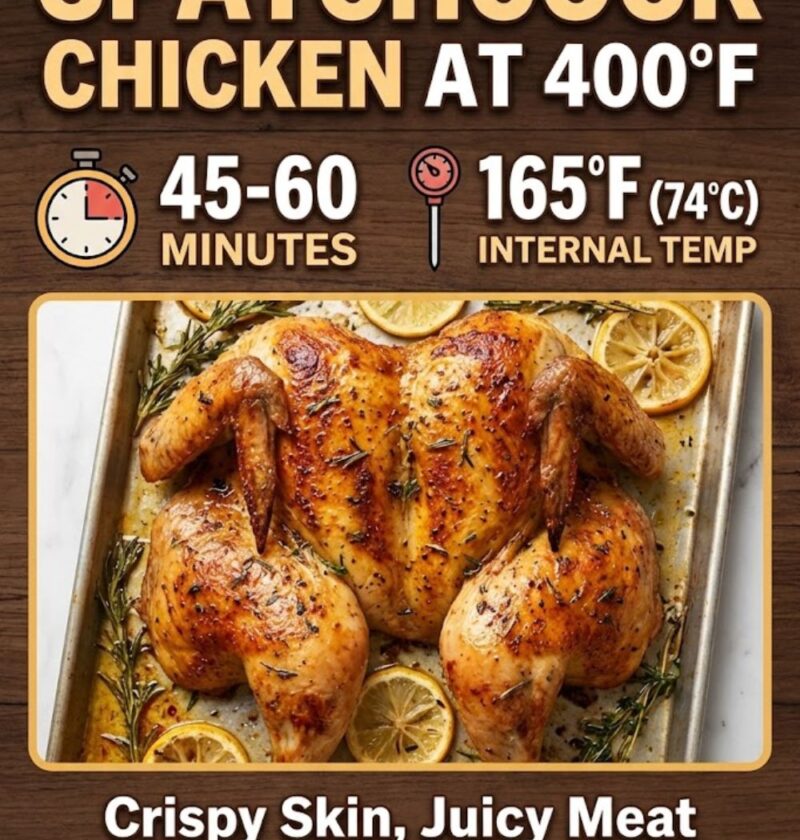
👉 A spatchcock chicken cooks at 400°F in 40–55 minutes.
| Chicken Weight | Cook Time at 400°F |
|---|---|
| 3 lb chicken | 40–45 minutes |
| 4 lb chicken | 45–50 minutes |
| 5 lb chicken | 50–55 minutes |
| 6 lb chicken | 55–65 minutes |
But here is the real golden rule:
Cook until the breast reaches 165°F and the thigh reaches 175°F.
The thermometer—not the clock—is the true judge of perfection.
🔥 Why Spatchcock Chicken Is So Special (The “Clacteur” Moment)
Roasting a spatchcock chicken feels like working with a smart, obedient, beautifully structured ingredient.
You flatten the bird, and instantly:
- The breast doesn’t dry out.
- The thighs cook fully without waiting forever.
- The skin crisps like a sheet of golden armor.
- Seasonings penetrate more evenly.
- The bird cooks faster, saving time and boosting flavor.
It’s the method chefs use when they want speed + flavor + texture + drama on a plate.
At 400°F, every part of the chicken experiences the same heat—this creates a balance between browning (the Maillard reaction) and moisture retention.
It’s not just cooking.
It’s technique with intention.

🔥 Internal Temperature Guide (The Heart of the Technique)
To make sure the chicken is safe AND juicy:
| Part | Temperature |
|---|---|
| Breast | 165°F |
| Thigh | 175°F |
Why two different temperatures?
- Chicken breast dries out quickly, so it shouldn’t go past 165°F.
- Thigh meat contains more connective tissue, which melts and turns tender around 175°F.
Spatchcocking lets both reach their ideal temperature at the same time, which almost never happens with a whole, unflattened chicken.
This is why chefs swear by it.
🔪 How to Spatchcock the Chicken (Chef’s Method)
This is where the transformation begins.
1. Place chicken breast-side down.
You should see the backbone centered.
2. Cut along both sides of the backbone.
Use sharp kitchen shears—no stress, no hesitation.
3. Remove the backbone entirely.
Save it for stock (a chef never wastes flavor).
4. Flip chicken breast-side up.
Spread the legs and flatten the wings.
5. Press down firmly on the breastbone.
You’ll hear a subtle crack—the sound of a perfectly flattened bird.
6. Tuck wings behind breasts.
This prevents burning and creates a cleaner presentation.
At this moment, your chicken is no longer ordinary—it’s a professional-grade ingredient.

🧂 How to Season Spatchcock Chicken (The Flavor Architecture)
Seasoning a whole bird requires intention.
Because the chicken lies flat, every bite should carry flavor.
Rub the chicken with:
- Olive oil or melted butter
- Kosher salt
- Freshly cracked black pepper
- Garlic powder
- Onion powder
- Smoked paprika
- Thyme or rosemary
Chef tip:
Loosen the skin gently and rub seasoning DIRECTLY onto the meat underneath.
This builds depth and keeps the skin crisp
🍗 How to Cook Spatchcock Chicken at 400°F (Step-by-Step Master Method)
1. Preheat oven to 400°F.
Hot, strong heat = crispy skin.
2. Place chicken on a sheet pan or cast-iron skillet.
Skin side up
Spread wide
Center of the oven for even air circulation
Add sliced lemon, garlic, carrots, onion, or potatoes underneath to catch drippings.
3. Roast 40–55 minutes.
Watch for color: deep golden brown is your goal.
You don’t need to flip the chicken—spatchcocking exposes the skin fully, so it crisps naturally.
4. Check the internal temperature.
Insert thermometer into:
- Thickest part of breast
- Inner thigh (not touching bone)
Perfect when breast is 165°F and thigh 175°F.
5. Broil for 2–3 minutes (Optional).
This is your restaurant-level finishing move for blistered, crunchy skin.
6. Rest for 10–15 minutes.
Resting redistributes the juices.
Cut too soon → juices run everywhere
Let it rest → meat stays moist and tender

🕒 Cook Time Chart (Precise and Tested)
| Weight | Cook Time | Notes |
|---|---|---|
| 3 lbs | 40–45 min | Very quick, check early |
| 4 lbs | 45–50 min | Most common size |
| 5 lbs | 50–55 min | Juicier thighs |
| 6 lbs | 55–65 min | Use a thermometer |
| 7 lbs | 65–75 min | Rare size but possible |
🍋 Chef-Style Seasoning Variations
1. Garlic Herb Butter
Butter + garlic + rosemary + thyme + lemon zest
Result: Classic French-style roast chicken.
2. Cajun Heat
Cajun seasoning + smoked paprika + chili powder
Result: Bold, spicy, smoky.
3. Tuscan Lemon
Lemon, oregano, garlic, olive oil
Result: Bright, savory, aromatic.
4. Honey Mustard Glaze
Honey + Dijon + paprika + garlic
Result: Sticky, glossy, caramelized skin.
5. BBQ Rub
Brown sugar + paprika + chili powder + cumin
Result: Sweet-smoky with dark mahogany skin.

🍽️ What to Serve With Spatchcock Chicken
Serve with sides that enhance richness:
- Roasted potatoes
- Garlic herb rice
- Green beans
- Caesar salad
- Baked or mashed sweet potatoes
- Grilled asparagus
- Creamy pasta
- Cornbread
- Roasted carrots
A spatchcock chicken pairs well with almost every cuisine because its flavor is neutral yet deep.
🧊 Storage & Reheating
Storage
- Fridge: 3–4 days
- Freezer: 2–3 months
Reheating (Best Method)
Oven
350°F for 15–20 minutes
Skin stays crisp, meat stays juicy.
Air fryer
350°F for 5–7 minutes
Great for crispy leftovers.
Microwave
1–2 minutes
Fast but softens the skin.

❓ Frequently Asked Questions
1. Can I cook spatchcock chicken at higher than 400°F?
Yes. Many chefs use 425°F or even 450°F for ultra-crisp skin.
But higher temperatures create risk:
- Breast may dry out
- Wings may burn
- Thighs may brown too fast
At 400°F, you get control, consistency, and balance—perfect for home cooks and pros alike.
2. Should I marinate the chicken before cooking?
Marinating adds depth of flavor, especially when using lemon, yogurt, herbs, or spicy rubs.
But here’s a chef secret:
Dry brining (salt alone) works better for crisp skin.
Marinades add flavor.
Dry brines add structure.
3. Do I need to flip the chicken during cooking?
Never.
Spatchcock chicken is designed to roast skin-side up the entire time.
Flipping interrupts browning and can tear the skin.
4. Why is my spatchcock chicken not crispy?
Common reasons:
- Skin wasn’t dried well
- Not enough salt
- Too much moisture on the pan
- Oven overcrowded
- No broil finish
Fix by patting the chicken dry and roasting uncovered.
5. Can I stuff a spatchcock chicken?
No.
Stuffing needs a cavity, which a flattened bird doesn’t provide.
Instead, roast vegetables beneath the chicken to absorb the dripping juices.
⭐ Final Clear Answer
A spatchcock chicken cooks in 40–55 minutes at 400°F, depending on weight.
The chicken is done when:
- Breast reaches 165°F
- Thigh reaches 175°F
Spatchcocking gives faster cooking, juicier meat, and beautifully crisp skin.
At 400°F, the chicken roasts with perfect balance—moist on the inside, golden on the outside, and packed with flavor.