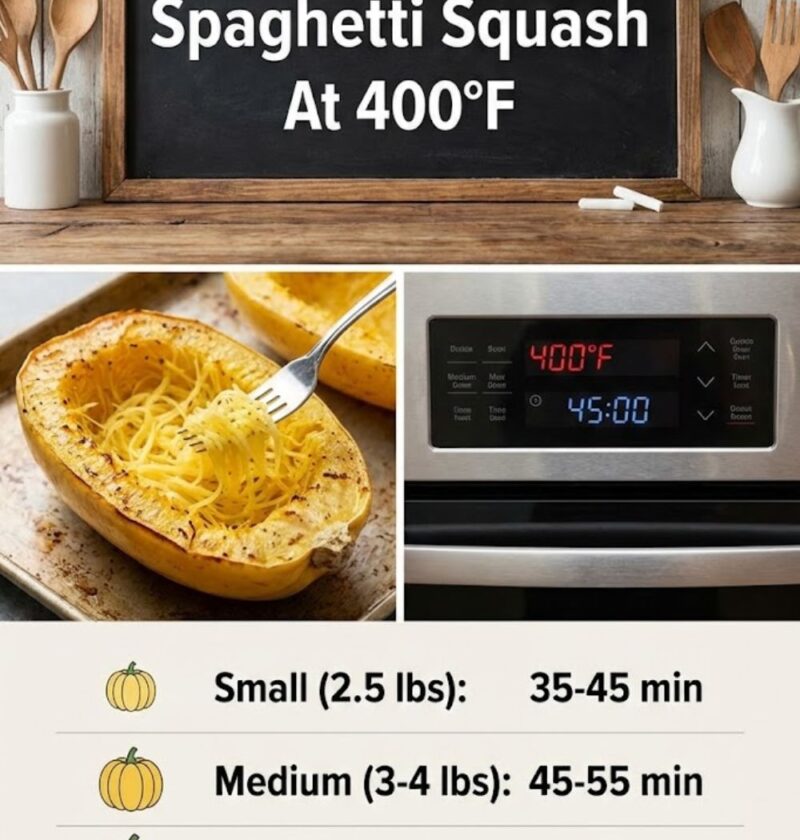
Cooking spaghetti squash at 400°F (204°C) is one of the most reliable ways to get soft, flavorful strands that look and feel like pasta. The higher heat brings out natural sweetness, reduces wateriness, and helps the squash roast evenly. This long and deep guide explains everything: exact times, texture control, signs of doneness, advanced tips, flavor boosters, mistakes to avoid, and multiple cooking methods.
Exact Cooking Time at 400°F (Complete Timing Chart)
| Squash Size | Oven Temp | Time Cut-Side Down | Time Cut-Side Up |
|---|---|---|---|
| Small (2–2.5 lbs) | 400°F | 35–40 min | 40–45 min |
| Medium (3 lbs) | 400°F | 40–45 min | 45–50 min |
| Large (4 lbs) | 400°F | 45–55 min | 50–60 min |
Average: Most spaghetti squash needs 40–55 minutes at 400°F.
Fast Tip: The more moisture you remove, the longer the strands stay firm.

How Heat Changes the Texture (Food Science Explained)
At 400°F, the oven heat does four important things:
1. Softens the Fibers
The squash has natural fibers that loosen when heated. At 400°F, they soften faster and pull apart into long, spaghetti-like strands.
2. Evaporates Moisture
High heat pushes out water. Less water = better texture. This is why roasting is better than steaming.
3. Caramelizes the Edges
When the cut side touches the baking sheet, the sugars brown slightly. This adds flavor.
4. Builds Stronger Strands
If the squash cooks too slow at low heat, strands become mushy. At 400°F, they stay firm but tender.
How To Prep Spaghetti Squash (Deep & Detailed)
1. Wash the squash
Remove dirt—important because the knife passes through the skin.
2. Cut the squash
Use a long sharp knife. Two ways to cut:
- Lengthwise halves → shorter strands, softer texture
- Crosswise rings → longest strands, dryer texture
- Whole squash → easiest but softest texture
3. Remove seeds
Scoop with a spoon. Do not remove the “meat”—only seeds and loose fibers.
4. Season
Rub with:
- Olive oil (prevents dryness)
- Salt (draws out water)
- Pepper or garlic powder (optional)
5. Bake
Place cut-side down for softer texture.
Place cut-side up for dryer, firmer strands.

How To Know It’s Done (Most Important Section)
Spaghetti squash is fully cooked when:
Texture Signs
- A fork slides into the flesh with no effort
- Strands pull apart easily
- Center is soft but not mushy
Visual Signs
- Outer skin wrinkles slightly
- Edges look golden
- Steam escapes when you press it
Touch Signs
- The squash gives a little when pressed
- Fork-test inside feels tender
Time Signs
If you reach 50–55 minutes, most squash will be done unless extremely large.
How To Fix Undercooked or Overcooked Squash
Undercooked (Crunchy strands)
Put it back in the oven:
+5–10 minutes at 400°F.
Overcooked (Mushy strands)
Try these fixes:
- Spread strands on a sheet pan → bake 5 minutes to dry them
- Mix with sauce to tighten texture
- Chill in fridge → they firm up
Texture Control (Deep Tips)
For Firmer, More Pasta-Like Strands
- Roast cut-side up
- Use less salt
- Bake 35–40 minutes, then check
- Spread strands after cooking to release steam
For Softer, Tender Strands
- Roast cut-side down
- Add more oil
- Bake 45–55 minutes
- Cover edges loosely with foil
For Perfect Long Strands
Cut into rings, not halves.
This follows the squash’s natural fiber direction.

How To Cook Whole Spaghetti Squash at 400°F (Deep Method)
If cutting is difficult:
- Pierce squash 10–12 times
- Place whole on a baking tray
- Bake 55–75 minutes
- Cool for 10 minutes
- Cut open, remove seeds, shred strands
This gives a softer, wetter texture but is the easiest method.
How To Cook Spaghetti Squash Faster (Advanced Tricks)
Microwave + Roast
- Microwave whole for 3–5 minutes
- Cut open easily
- Roast 30–35 minutes at 400°F
Instant Pot
Cook halves for 7–8 minutes on High
(But roasting gives better flavor.)

Flavor Boosting Ideas (Rich Section)
Seasonings That Match the Flavor
- Salt, pepper
- Garlic powder
- Onion powder
- Italian seasoning
- Smoked paprika
- Chili flakes
- Lemon zest
Oil Options
- Olive oil
- Avocado oil
- Butter (after roasting)
- Garlic-infused oil
Add On Top After Cooking
- Parmesan cheese
- Fresh herbs
- Pesto
- Bolognese
- Alfredo sauce
- Meatballs
- Sautéed vegetables
Why 400°F Is Better Than 375°F or 350°F
| Temp | Time | Texture | Flavor |
|---|---|---|---|
| 350°F | 55–70 min | Soft, sometimes watery | Mild |
| 375°F | 45–60 min | Balanced | Better browning |
| 400°F | 40–55 min | Best mix of firm + tender | Sweet, roasted, rich |
400°F gives the deepest flavor and best strands.
Common Mistakes (Deep List + Fixes)
❌ Using too much oil
Strands become greasy.
Fix: 1–2 teaspoons per half is enough.
❌ Oversalting before roasting
Salt pulls out water → soggy texture.
Fix: Add salt after roasting for firmer strands.
❌ Cutting uneven halves
One cooks, the other stays raw.
Fix: Measure halves visually before baking.
❌ Leaving squash too long in oven
Strands break into mush.
Fix: Check at 35–40 minutes.
❌ Shredding when too hot
Heat makes strands fragile.
Fix: Rest 5 minutes before shredding.

Serving Ideas (Rich & Long)
Spaghetti squash goes well with:
- Marinara + basil
- Alfredo + grilled chicken
- Garlic butter + parsley
- Pesto + cherry tomatoes
- Ground turkey or beef sauce
- Parmesan + black pepper
- Shrimp scampi
- Roasted vegetables
- Creamy mushroom sauce
- Chili or stew on top
It works as:
- A low-carb pasta replacement
- A base for bowls
- A side dish
- A stuffed squash boat
- A casserole ingredient
Full FAQ Section (Deep & Extended)
1. What is the best cooking time for spaghetti squash at 400°F?
Most squash needs 40–55 minutes at 400°F depending on size, shape, and moisture level.
2. Do larger squash need more time?
Yes—larger squash have thicker walls and need 50–60 minutes.
3. Should I flip the squash while roasting?
No. Leave it in one position for even cooking.
4. Do you salt before or after roasting?
Salt after roasting for firmer strands.
5. Why is my squash watery?
You might have:
- Used too much salt
- Roasted cut-side down
- Overcooked it
- Used a very fresh squash (more water inside)
6. How to dry watery spaghetti squash?
Spread strands on a sheet pan and roast 5–10 minutes.
7. How long does cooked squash last?
3–4 days in the fridge.
8. Can you freeze spaghetti squash?
Yes. Freeze strands up to 3 months.
9. Should I peel spaghetti squash?
No. Roast with skin on.
10. Can I air fry spaghetti squash?
Yes. 380°F for 20–25 minutes.
Conclusion
At 400°F, spaghetti squash cooks in 40–55 minutes, giving the best mix of soft, tender, and flavorful strands. This temperature delivers great texture, less water, deeper flavor, and a perfect pasta-like feel. With the right prep, seasoning, and roasting method, you get long, golden strands ready for any sauce or topping.