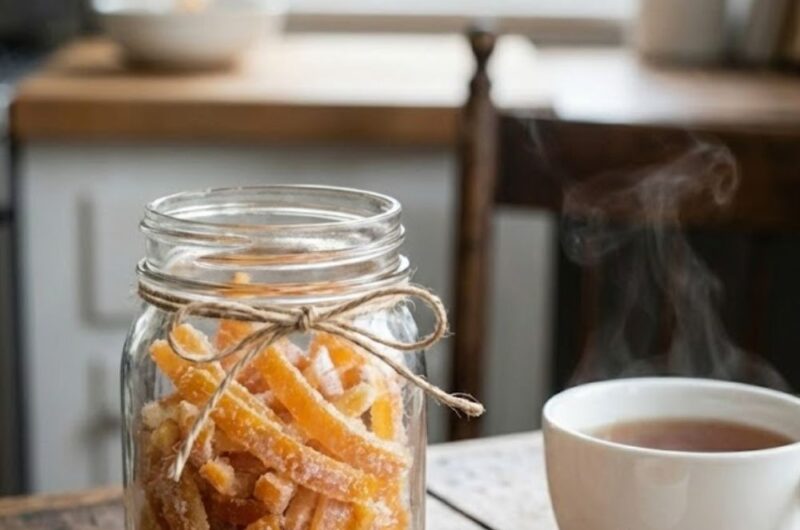
There is something so deeply satisfying about a recipe that turns “trash” into treasure. In the Gaines household, nothing goes to waste, and these Joanna Gaines Candied Orange Peels are the perfect example. I’ve seen these glistening in jars at high-end bakeries for years, but after testing the Magnolia Table method in my own kitchen, I’m convinced they are best made at home.
These aren’t just for decoration. They are chewy, sugary, and have a concentrated citrus punch that makes them dangerously snackable. Whether you’re looking to level up your holiday gift baskets or just want a sophisticated garnish for your evening cocktail, this is the only guide you’ll ever need.
If you love citrus as much as I do, you have to try my Pioneer Woman Orange Monkey Bread
or these Orange Infused Shortbread Cookies.
🧡 Why This Recipe Works
- The “Triple Blanch” Method: This is the non-negotiable secret. It systematically strips away the bitter oils from the white pith, leaving behind only the bright orange flavor.
- Minimalist Ingredients: You likely have everything you need in your pantry right now.
- Long Shelf Life: These beauties stay fresh for weeks, making them the ultimate “make-ahead” treat.
🍊 What You’ll Need to Get Started
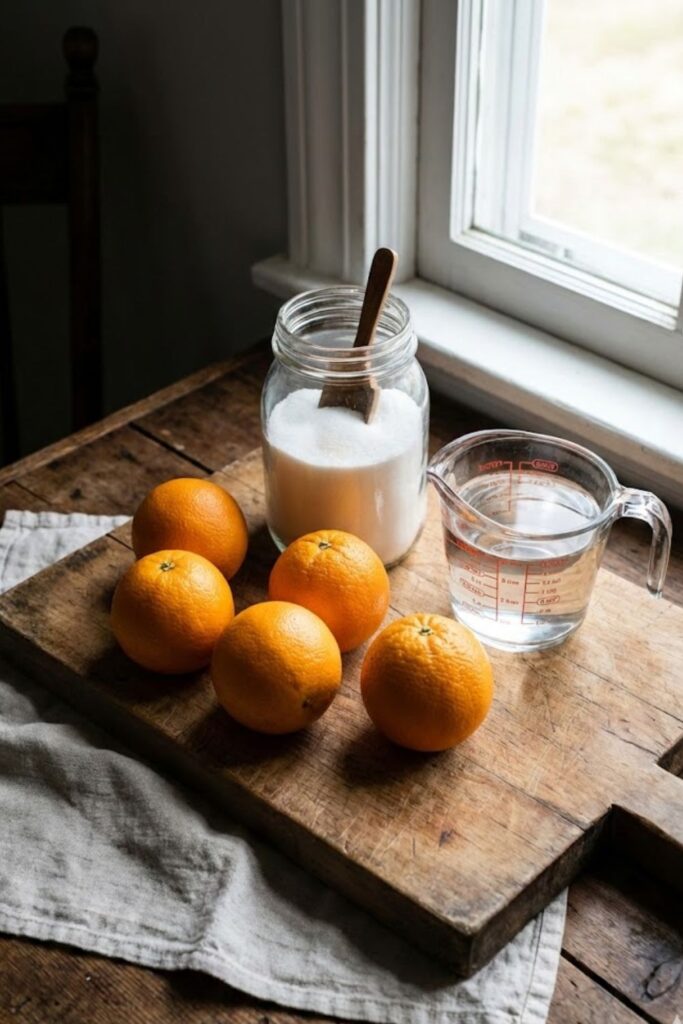
Oranges: I found that Navel oranges work best because their skin is thick and sturdy. I also tried a batch with Cara Cara oranges, which gave a beautiful pinkish-red hue! Sugar: Use standard granulated white sugar. You’ll need a batch for the syrup and a fresh bowl for the final “sparkle” coating. Water: Essential for the three rounds of blanching and the final sugar syrup.
Can I Use Other Citrus Peels?
Absolutely! You can definitely use this exact method for other citrus. In fact, once you master the “Triple Blanch,” you can turn your kitchen into a full-blown confectionery.
Based on my tests at home, here is how different fruits behave with this recipe:
1. Lemons and Limes
These are the easiest swaps. Because their skins are thinner than navel oranges, they tend to candy faster.
- The Result: Much more tart and “bright.”
- Pro Tip: These are incredible when chopped up and baked into shortbread or used to garnish a gin and tonic.
2. Grapefruit
This is for the true citrus lovers. Grapefruit is significantly more bitter than oranges.
- The Adjustment: I highly recommend a fourth round of blanching. That extra 5-minute boil is the difference between a delicious treat and a bitter shock.
- The Result: These make the most beautiful, oversized “ruby” candy strips.
3. Blood Oranges
If you can find these, use them!
- The Result: The peels turn a stunning, deep garnet color that looks very high-end. They have a slightly raspberry-like undertone that pairs perfectly with a dark chocolate dip.
The “Citrus Scale” for Blanching
| Fruit | Bitterness Level | Recommended Blanching |
| Lime | Low | 2 – 3 Times |
| Lemon | Medium | 3 Times |
| Navel Orange | Medium | 3 Times |
| Grapefruit | High | 4 Times |
One Quick Warning
Avoid using “thin-skinned” citrus like Clementines or Tangerines. Their peels are so delicate that they often disintegrate during the triple-boiling process. Stick to the thicker-skinned varieties for that satisfying, chewy “gummy candy” texture.
🍟 How to Make Candied Orange Peels
1. Prep the Citrus
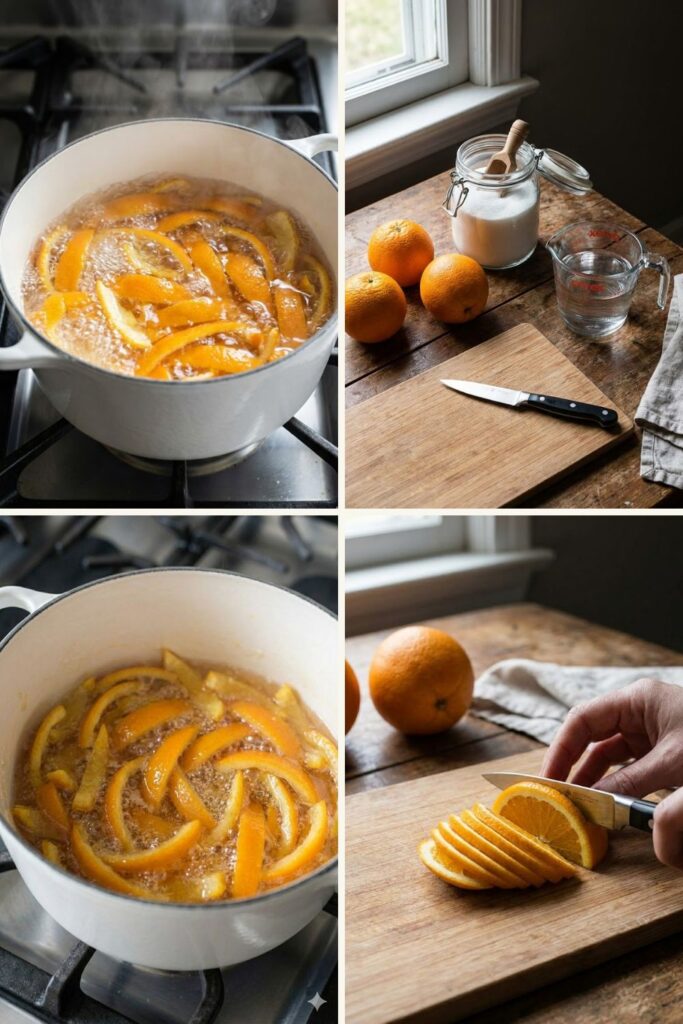
Slice the top and bottom off your orange so it can stand flat. Use a sharp paring knife to score the skin into four vertical segments, being careful not to cut into the fruit itself. Peel the skin away and slice into long, thin strips (about 1/4 inch wide).
My Test Kitchen Tip: Don’t worry if there is a lot of white pith attached! Most recipes tell you to scrape it off, but Joanna’s method keeps it on for a chewier, more substantial candy. The blanching takes care of the bitterness.
2. The Triple Blanch (Don’t Skip This!)
Place your strips in a pot and cover with cold water. Bring to a rolling boil for 5 minutes, then drain. Repeat this process two more times with fresh water. By the third round, you’ll notice the water is much clearer—this means the bitterness is gone.
3. Simmer in the “Liquid Gold”
In a clean pot, combine 2 cups of sugar and 1 cup of water. Stir until the sugar dissolves and the mixture begins to simmer. Add your blanched peels. Turn the heat down to low and let them gently simmer for about 45 to 60 minutes.
4. The Transformation
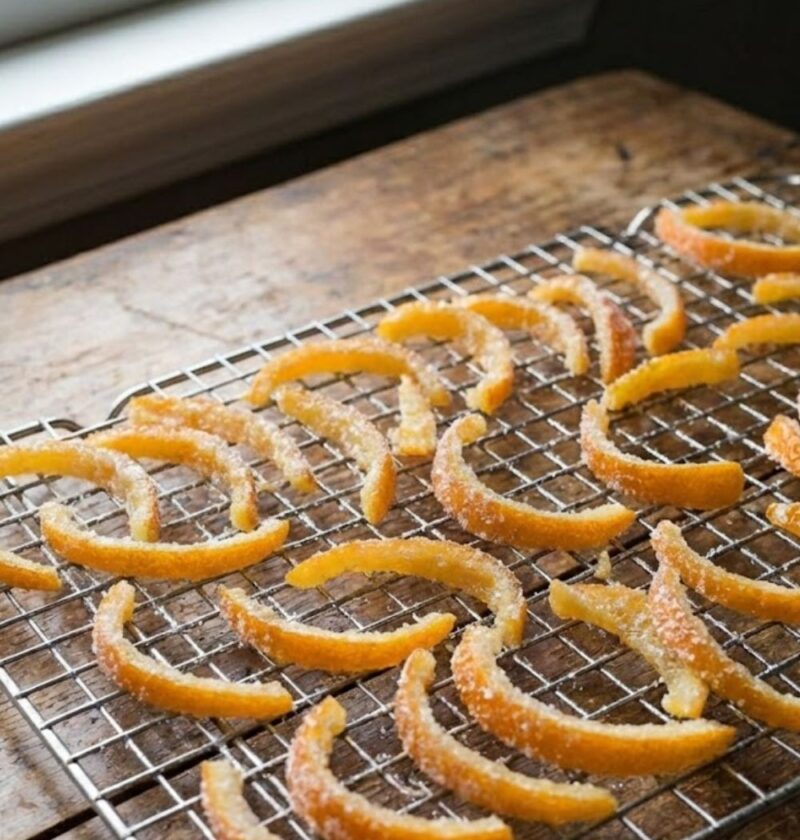
You’ll know they’re ready when the peels become translucent and look like stained glass. The syrup will be thick and bubbly.
5. The Sugar Dusting
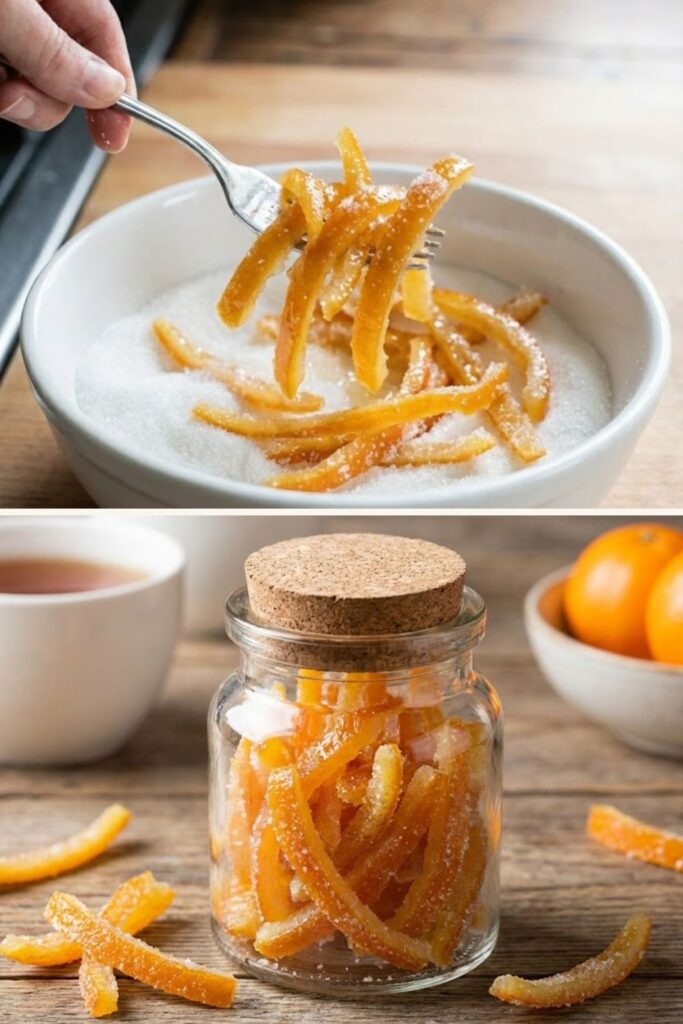
Use a slotted spoon to lift the peels out of the syrup (let the excess drip off for a second!) and drop them into a bowl of granulated sugar. Toss them until every inch is coated in crystals.
6. The Drying Phase
Lay the peels out on a wire cooling rack. This is the hardest part: Waiting. They need at least 4 hours (I prefer overnight) to dry out so they aren’t sticky to the touch.
💡 Pro Tips from My Kitchen
- Save the Leftover Syrup: Whatever you do, do not pour that syrup down the drain! It is now a thick, orange-infused simple syrup. I’ve been using mine in my morning tea and even drizzled over vanilla ice cream. It is incredible.
- Check the Temperature: If you have a candy thermometer, you’re looking for the syrup to be around 230°F (110°C). If you go too high, the peels will become hard and crunchy rather than chewy.
- The “Cold Water” Start: Always start your blanching with cold water. It helps draw out the bitterness more effectively than dropping them straight into boiling water.
Frequently Asked Questions
Can I use this for other fruit?
Absolutely. I’ve used this exact method for lemon and grapefruit peels. Just note that grapefruit is much more bitter and may require a 4th round of blanching.
Why are my peels sticky even after drying?
This usually happens if the humidity in your house is high or if the sugar syrup didn’t cook down enough. If they stay tacky, just give them another roll in some fresh sugar!
How do I serve these?
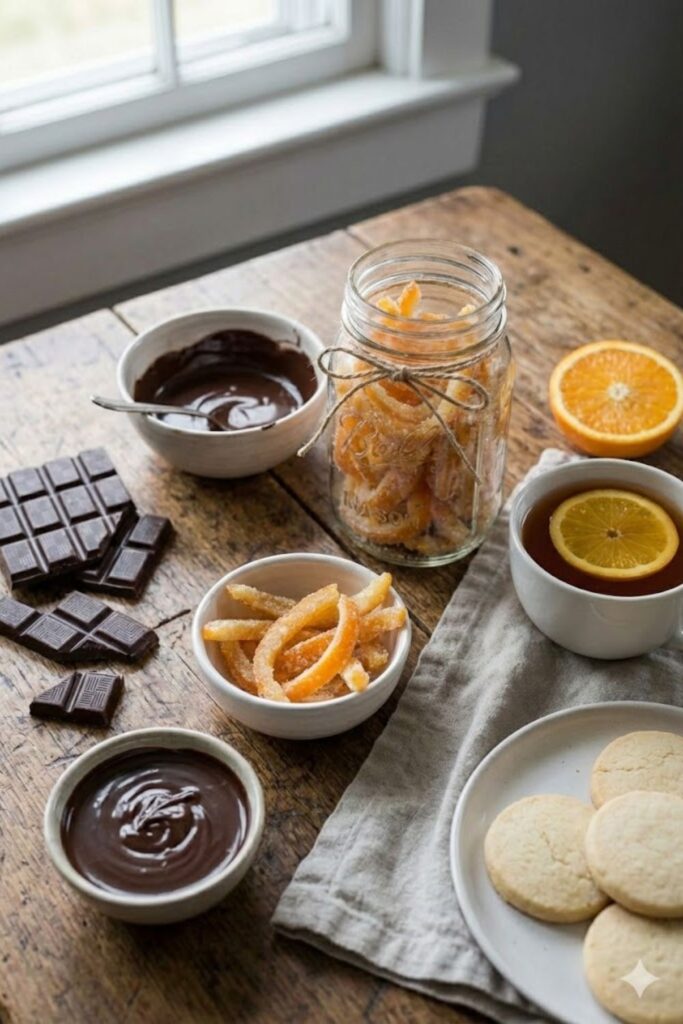
Apart from snacking on them plain, I love dipping the ends in melted dark chocolate and sprinkling a tiny bit of sea salt on top. They look like they came from a French patisserie!
If you like this Homemade Candied Orange Peel be sure to take a look at some of my other recipes!
- Pioneer Woman Texas Trash Recipe
- Pioneer Woman Rum Balls
- Pioneer Woman Slow Cooker Hot Chocolate
- Joanna Gaines Strawberry Butter Recipe
Candied Orange Peel Nutrition Facts
| Amount Per Serving | % Daily Value* |
| Calories | 95 |
| Total Fat | 0.1g (0%) |
| Sodium | 1mg (0%) |
| Total Carbohydrates | 25g (9%) |
| Dietary Fiber | 1.5g (5%) |
| Sugars | 22g |
| Protein | 0.3g (1%) |
| Vitamin C | 15% |
Joanna Gaines Candied Orange Peel Recipe
Course: Dessert, Sides, AppetizersCuisine: AmericanDifficulty: Easy39
servings20
minutes1
hour95
kcalThere is something so deeply satisfying about a recipe that turns “trash” into treasure. In the Gaines household, nothing goes to waste, and these Joanna Gaines Candied Orange Peels are the perfect example. I’ve seen these glistening in jars at high-end bakeries for years, but after testing the Magnolia Table method in my own kitchen, I’m convinced they are best made at home.
Ingredients
4 Large Navel Oranges
2 ½ Cups Granulated Sugar (divided)
1 Cup Water
Optional: 4 oz Dark Chocolate for dipping
Directions
- Slice the orange rinds into 1/4 inch strips.
- Boil the peels in water for 5 minutes, then drain. Repeat 3 times.
- Simmer 2 cups sugar and 1 cup water until dissolved.
- Cook peels in the syrup for 45-60 minutes on low heat until translucent.
- Toss in the remaining 1/2 cup of sugar while still warm.
- Dry on a wire rack for 4-24 hours.
- Store in an airtight container for up to 3 weeks.
Notes
- Leave the Pith: Don’t scrape the white part off; the blanching softens it into a delicious, gummy-like candy.
Save the Syrup: Keep the leftover orange syrup for cocktails, tea, or drizzling over cake.
Undercook the Syrup: If the syrup gets too hot (above 230°F), the peels will be hard instead of chewy.
Don’t Waste: Save the fruit for juicing or snacking since you only need the skins.
Storage: Keeps for 3 weeks at room temperature or 2 months in the fridge.