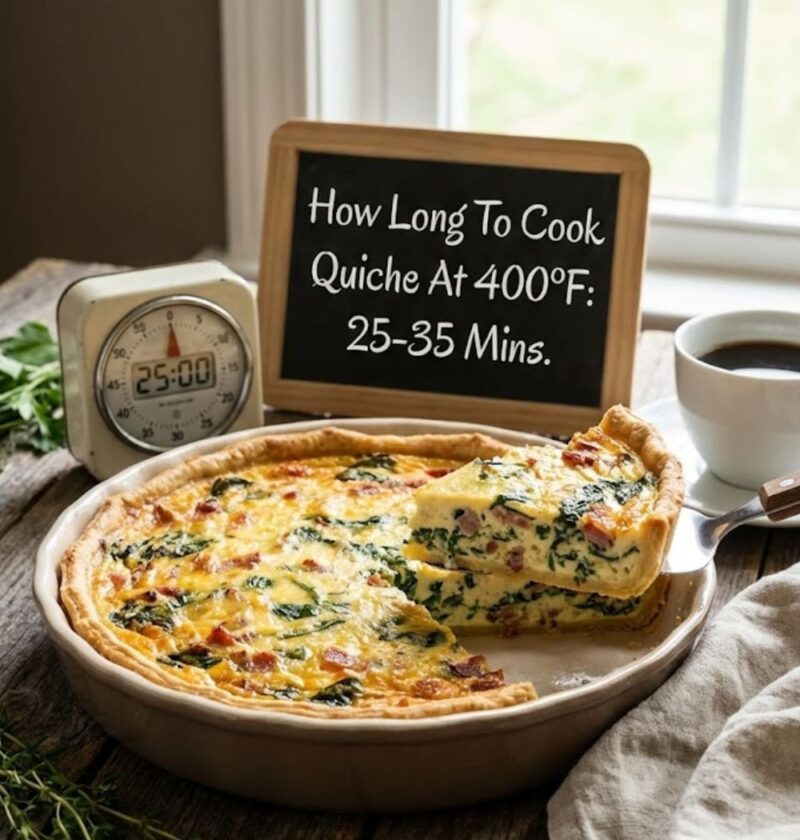
A quiche bakes at 400°F for 25–35 minutes, depending on the size, filling, and thickness of the custard. This hotter temperature creates a firm, golden top while keeping the inside creamy. Smaller quiches cook faster, and deep-dish quiches need extra time.
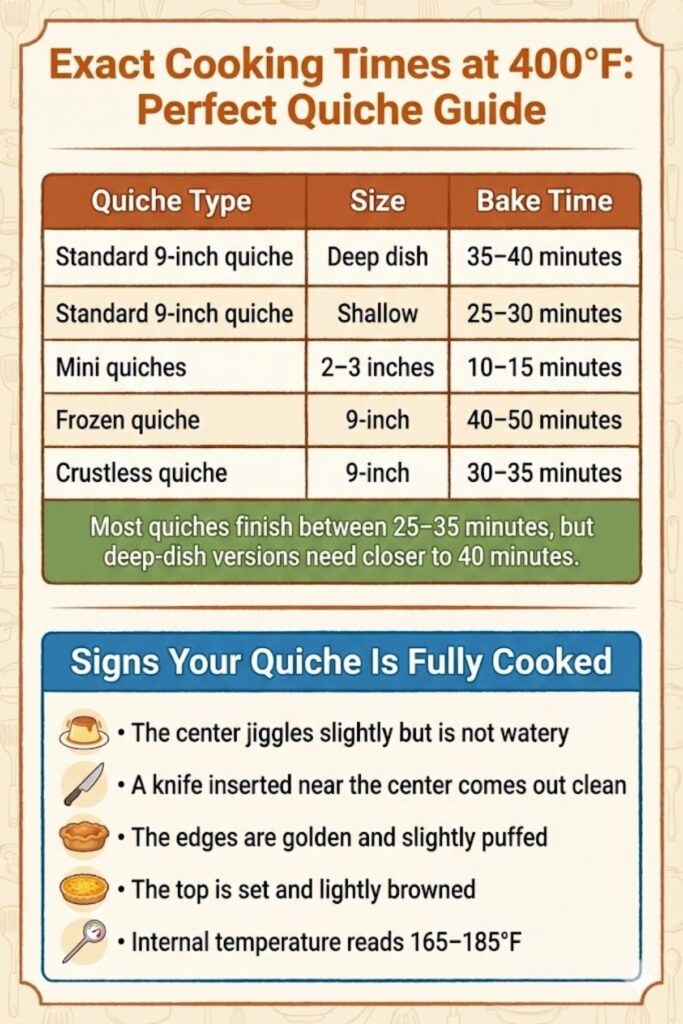
Exact Cooking Times at 400°F
| Quiche Type | Size | Bake Time |
|---|---|---|
| Standard 9-inch quiche | Deep dish | 35–40 minutes |
| Standard 9-inch quiche | Shallow | 25–30 minutes |
| Mini quiches | 2–3 inches | 10–15 minutes |
| Frozen quiche | 9-inch | 40–50 minutes |
| Crustless quiche | 9-inch | 30–35 minutes |
Most quiches finish between 25–35 minutes, but deep-dish versions need closer to 40 minutes.
Signs Your Quiche Is Fully Cooked
Instead of only using time, check these visual signs:
- The center jiggles slightly but is not watery
- A knife inserted near the center comes out clean
- The edges are golden and slightly puffed
- The top is set and lightly browned
- Internal temperature reads 165–185°F
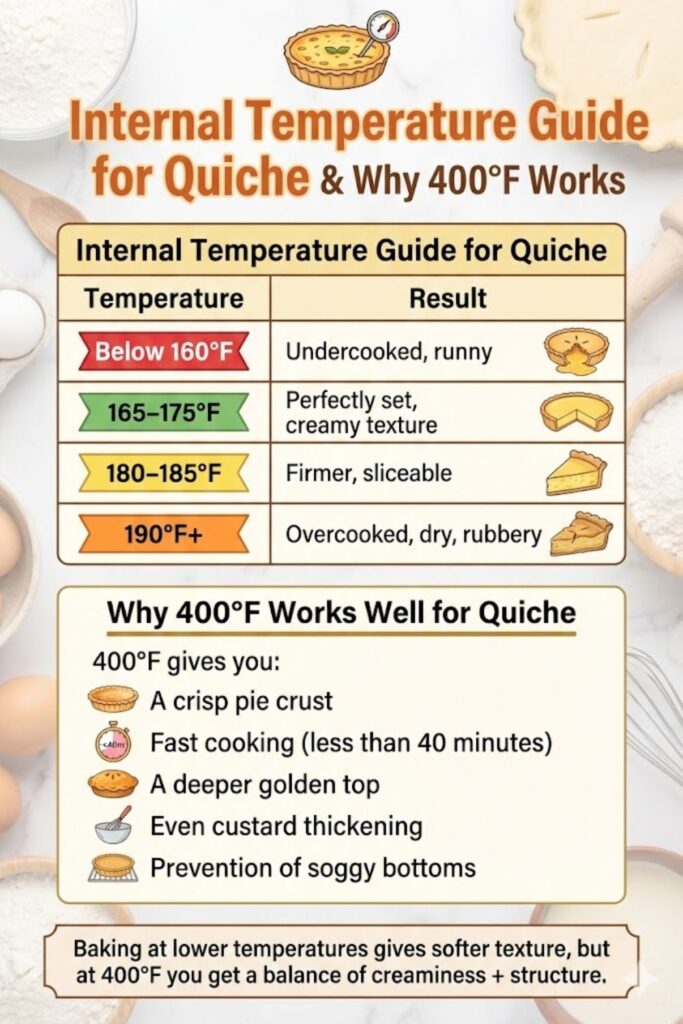
Internal Temperature Guide for Quiche
| Temperature | Result |
|---|---|
| Below 160°F | Undercooked, runny |
| 165–175°F | Perfectly set, creamy texture |
| 180–185°F | Firmer, sliceable |
| 190°F+ | Overcooked, dry, rubbery |
Why 400°F Works Well for Quiche
400°F gives you:
- A crisp pie crust
- Fast cooking (less than 40 minutes)
- A deeper golden top
- Even custard thickening
- Prevention of soggy bottoms
Baking at lower temperatures gives softer texture, but at 400°F you get a balance of creaminess + structure.
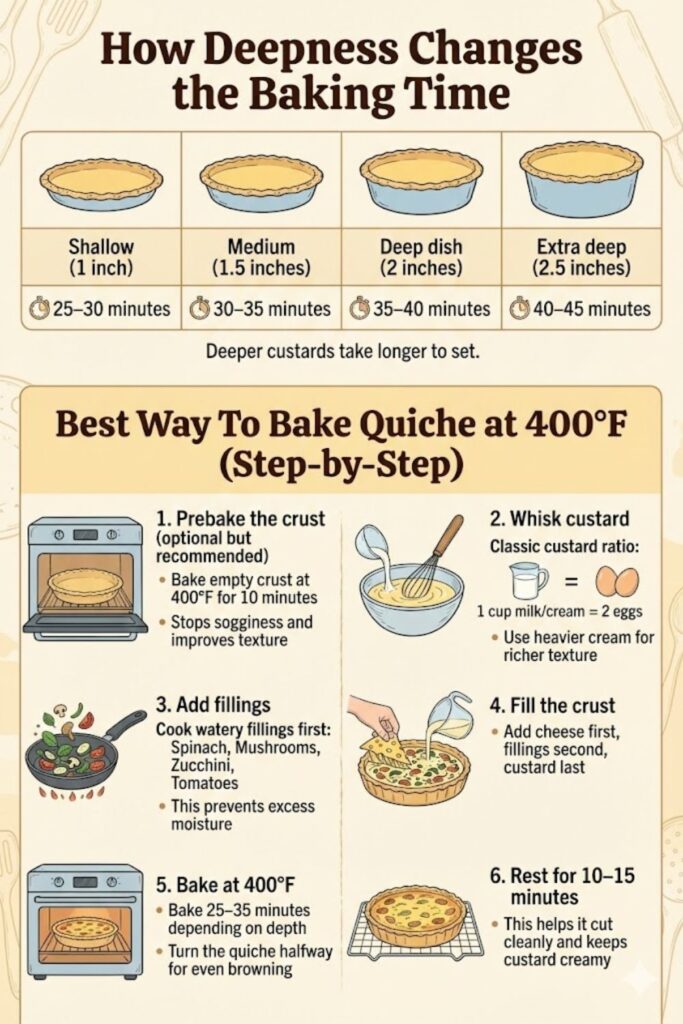
How Deepness Changes the Baking Time
| Depth of Quiche | Extra Time Needed |
|---|---|
| Shallow (1 inch) | 25–30 minutes |
| Medium (1.5 inches) | 30–35 minutes |
| Deep dish (2 inches) | 35–40 minutes |
| Extra deep (2.5 inches) | 40–45 minutes |
Deeper custards take longer to set.
Best Way To Bake Quiche at 400°F (Step-by-Step)
1. Prebake the crust (optional but recommended)
- Bake empty crust at 400°F for 10 minutes
- Stops sogginess and improves texture
2. Whisk custard
Classic custard ratio:
- 1 cup milk/cream = 2 eggs
Use heavier cream for richer texture.
3. Add fillings
Cook watery fillings first:
- Spinach
- Mushrooms
- Zucchini
- Tomatoes
This prevents excess moisture.
4. Fill the crust
Add cheese first, fillings second, custard last.
5. Bake at 400°F
- Bake 25–35 minutes depending on depth
- Turn the quiche halfway for even browning
6. Rest for 10–15 minutes
This helps it cut cleanly and keeps custard creamy.
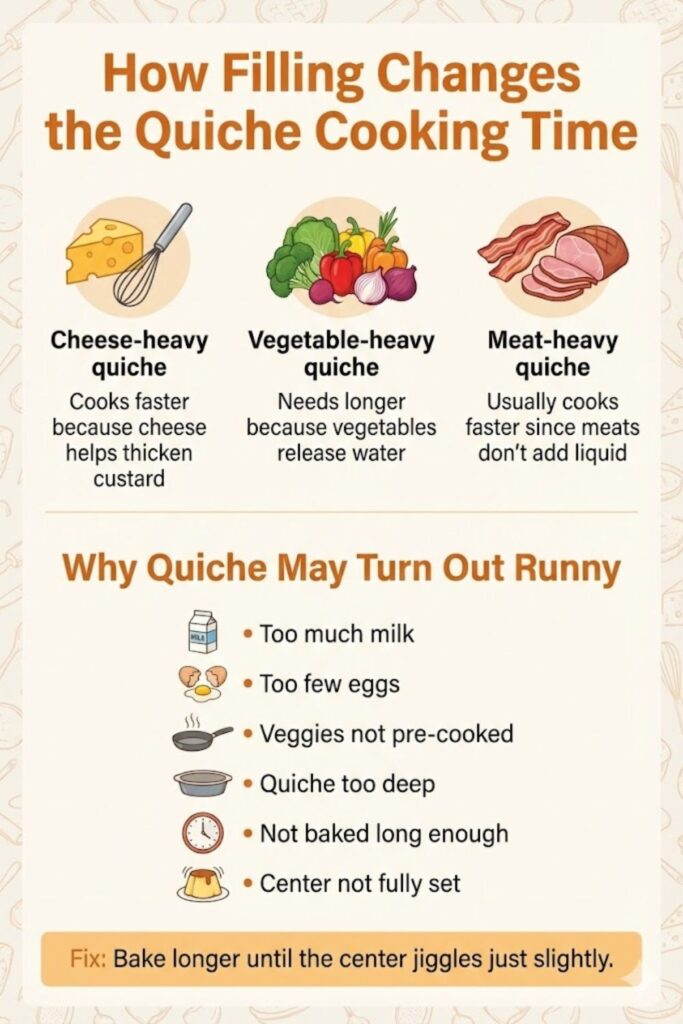
How Filling Changes the Cooking Time
Different fillings affect moisture + bake time:
Cheese-heavy quiche
Cooks faster because cheese helps thicken custard.
Vegetable-heavy quiche
Needs longer because vegetables release water.
Meat-heavy quiche
Usually cooks faster since meats don’t add liquid.
Why Quiche May Turn Out Runny
If your quiche is runny after baking at 400°F, the cause is usually:
- Too much milk
- Too few eggs
- Veggies not pre-cooked
- Quiche too deep
- Not baked long enough
- Center not fully set
Fix:
Bake longer until the center jiggles just slightly.
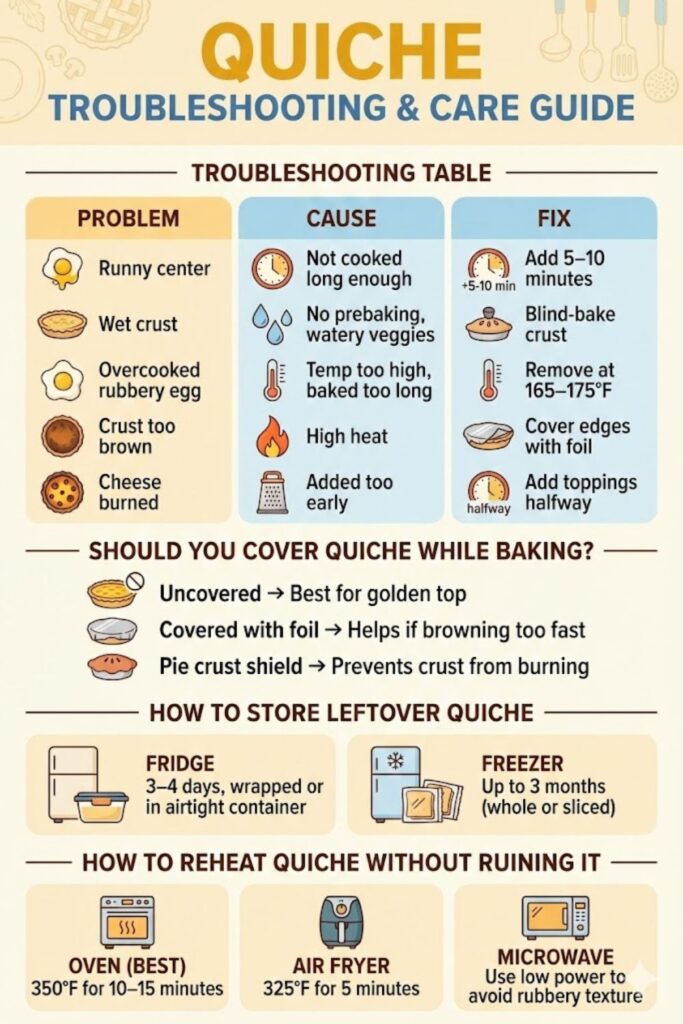
Troubleshooting Table
| Problem | Cause | Fix |
|---|---|---|
| Runny center | Not cooked long enough | Add 5–10 minutes |
| Wet crust | No prebaking, watery veggies | Blind-bake crust |
| Overcooked rubbery egg | Temp too high, baked too long | Remove at 165–175°F |
| Crust too brown | High heat | Cover edges with foil |
| Cheese burned | Added too early | Add toppings halfway |
Should You Cover Quiche While Baking?
- Uncovered → Best for golden top
- Covered with foil → Helps if browning too fast
- Pie crust shield → Prevents crust from burning
How to Store Leftover Quiche
Fridge
3–4 days, wrapped or in airtight container
Freezer
Up to 3 months (whole or sliced)
How to Reheat Quiche Without Ruining It
Oven (Best)
350°F for 10–15 minutes
Air Fryer
325°F for 5 minutes
Microwave
Use low power to avoid rubbery texture
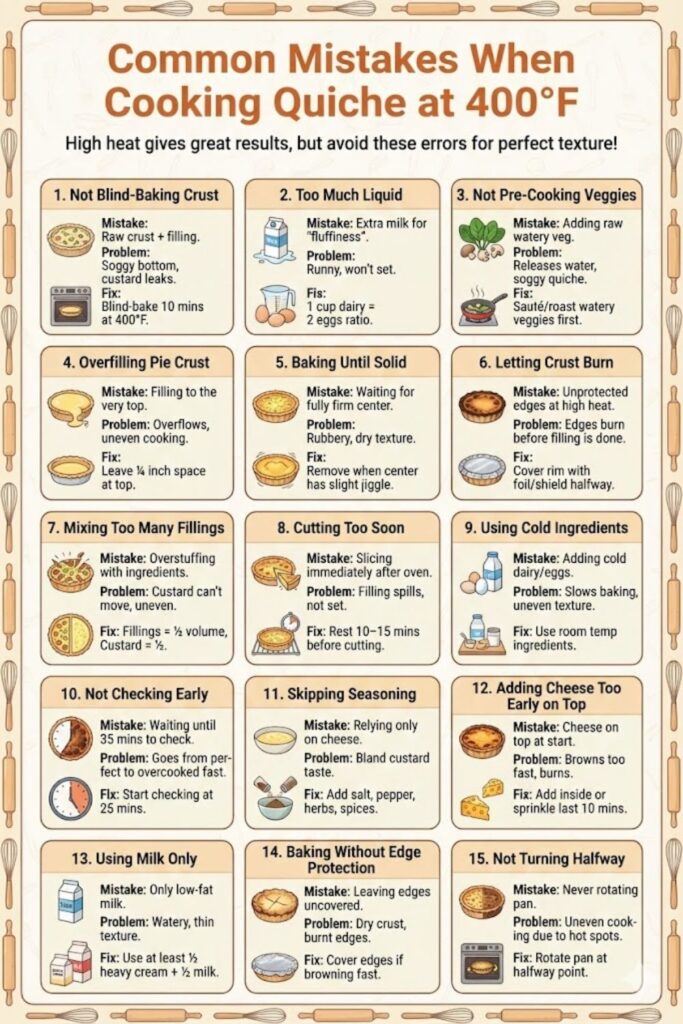
Common Mistakes When Cooking Quiche at 400°F
Cooking quiche at a higher temperature like 400°F gives great results, but many people make mistakes that affect the texture, crust, and cooking time. Here are the most common errors and how to fix each one.
1. Not Blind-Baking (Pre-Baking) the Crust
Mistake: Putting the raw crust in the oven with the filling.
Problem: The bottom becomes soggy because the custard leaks into the dough.
Fix: Blind-bake the crust for 10 minutes at 400°F before adding the filling.
2. Using Too Much Liquid in the Custard
Mistake: Adding extra milk or cream to make the quiche “fluffier.”
Problem: The quiche turns runny and never sets in the center.
Fix: Follow the rule:
1 cup dairy → 2 eggs
Don’t exceed this ratio.
3. Not Pre-Cooking Watery Vegetables
Mistake: Adding raw spinach, mushrooms, or tomatoes.
Problem: They release water during baking and make the quiche watery.
Fix: Sauté or roast all watery vegetables before adding them.
4. Overfilling the Pie Crust
Mistake: Filling the crust up to the very top.
Problem: The custard overflows and prevents even cooking.
Fix: Leave ¼ inch space at the top of the crust.
5. Baking Until the Center Is Completely Solid
Mistake: Waiting for the middle to look fully firm before removing it.
Problem: Overbaked quiche becomes rubbery and dry.
Fix: A perfect quiche should have a slight jiggle in the center when you take it out.
6. Letting the Crust Burn
Mistake: High-temperature cooking without protecting the crust edge.
Problem: The edges turn dark before the filling is done.
Fix: Cover the rim with foil or a pie crust shield halfway through baking.
7. Mixing Too Many Fillings
Mistake: Overstuffing the quiche with meat, vegetables, cheese, etc.
Problem: Custard can’t move around the fillings → uneven cooking.
Fix: Fillings should be only ½ of the total volume, custard the other half.
8. Cutting the Quiche Too Soon
Mistake: Slicing the quiche immediately after removing it from the oven.
Problem: The filling spills out because it has not set.
Fix: Let it rest 10–15 minutes before cutting.
9. Using Cold Ingredients
Mistake: Adding cold milk, cold eggs, or cold vegetables into the crust.
Problem: Cold ingredients slow baking and create uneven texture.
Fix: Let ingredients come to room temperature before mixing.
10. Not Checking Early Enough
Mistake: Waiting until 35 minutes to check for doneness.
Problem: Quiche can go from perfect → overcooked quickly at 400°F.
Fix: Start checking at 25 minutes.
11. Skipping Seasoning
Mistake: Relying only on cheese for flavor.
Problem: The custard can taste bland.
Fix: Add salt, pepper, nutmeg, garlic powder, onion powder, or herbs to the egg mixture.
12. Adding Cheese Too Early on Top
Mistake: Adding cheese on the surface at the start of cooking.
Problem: It browns too fast and sometimes burns.
Fix: Add cheese inside the quiche or sprinkle lightly during the last 10 minutes.
13. Using Milk Only Instead of Cream
Mistake: Using only low-fat milk to “lighten” the quiche.
Problem: The quiche becomes watery and thin.
Fix: Use at least ½ heavy cream + ½ milk for the best texture.
14. Baking at 400°F Without Protecting the Edges
Mistake: Leaving the quiche uncovered the whole time at high heat.
Problem: Dry crust, burnt edges.
Fix: Cover edges with foil if browning too fast.
15. Not Turning the Quiche Halfway
Mistake: Never rotating the quiche in the oven.
Problem: One side cooks darker because ovens have hot spots.
Fix: Rotate the pan at the halfway point.
FAQs
1. Can I bake a quiche at 400°F without burning the crust?
Yes, just prebake lightly and use foil on edges if needed.
2. Should I use milk or cream for quiche?
Cream gives richer texture; milk makes it lighter.
3. Do I need to blind-bake the crust?
Not required, but highly recommended for crispiness.
4. Why does my quiche crack on top?
It was baked too long or at too high heat.
5. Can I bake quiche from frozen?
Yes, add 10–15 minutes extra.